How Pokémon Card Vending Machines Work
A trading card vending machine is a locked retail cabinet that sells sealed product without a cashier. It sounds simple, and mechanically it is. What makes it work is everything around the cabinet: sourcing, pricing, restocking and the choice of where it sits.
October 14, 2026 · 7 min read · Province & Vend
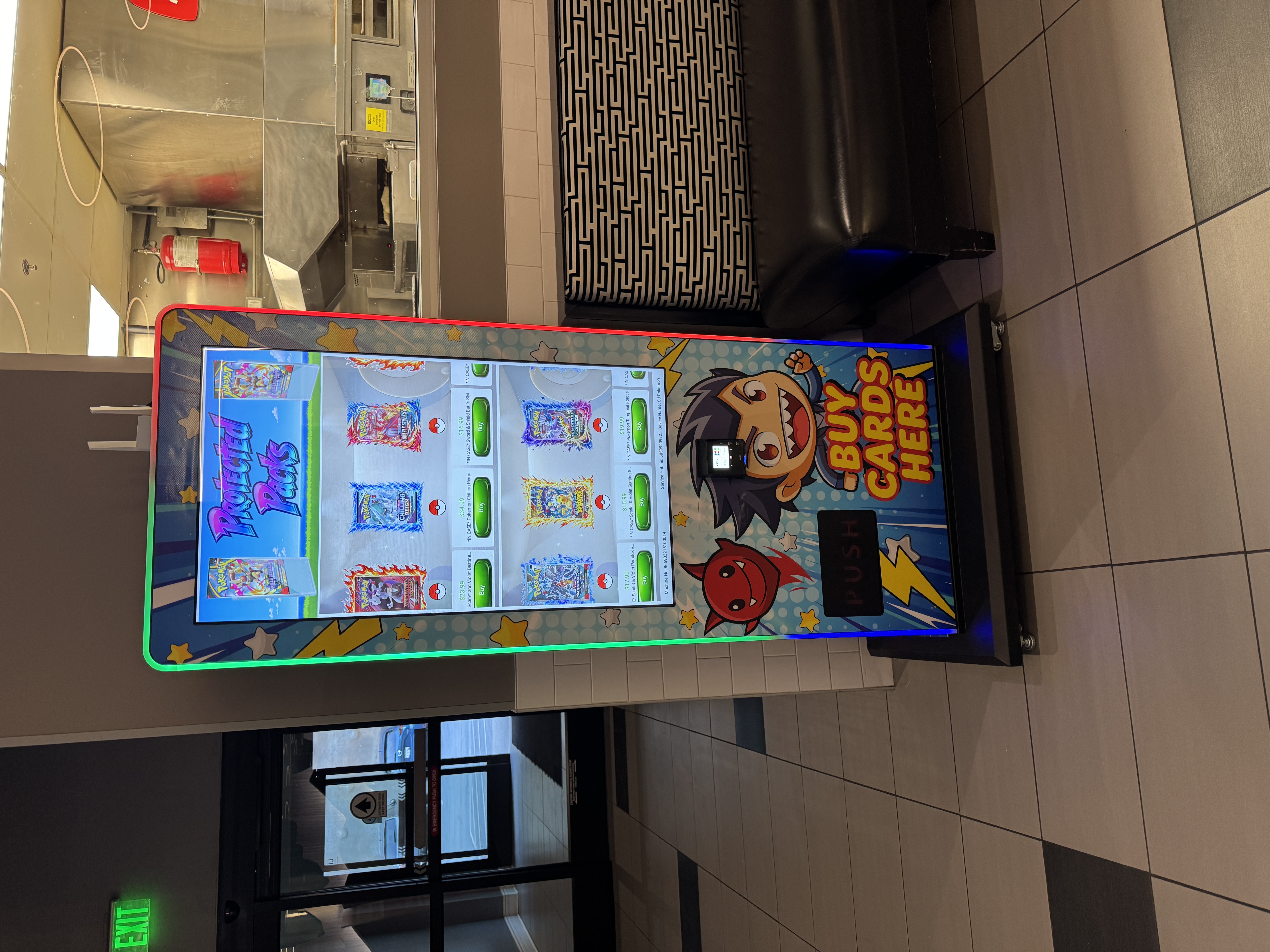
Most people meet a card vending machine as a customer: pick a pack, tap a card, take it from the slot. Business owners meet it as a question, usually some version of 'does this actually work, and what would it ask of me?'
This is an attempt to answer that properly, from the operator's side, without a sales pitch wrapped around it.
What is inside the cabinet
A card machine is stocked with sealed product only: booster packs, tins, and boxed collections. Nothing is opened, weighed, searched or repackaged. That rule is not a marketing preference, it is the entire basis of the category. Collectors inspect seams and wrap before they buy, and one resealed pack in a cabinet ends the trust that makes repeat purchases possible.
Shelving is sized for card product rather than snack bags or cans. Packs need to sit flat and be dispensed without crushing, and tins and boxes need a compartment that presents them properly. A general-purpose snack machine fitted with card product will damage stock, jam, and look like an afterthought.
- Sealed packs, tins and boxed sets, sourced through authorised distribution
- Locked steel and laminated glass, with product visible but not reachable
- Shelving specified for card product rather than general vending
- A mix set per location, not a national planogram
How a purchase actually completes
The customer selects a product on the machine's interface, pays by card or mobile wallet, and the machine dispenses the item and records the transaction. There is no cash in the loop at any point. That removes the float, the drop and the count, and it removes the reason card product usually lives behind a counter.
When a dispense fails, the machine reports the fault. Refunds are handled by the operator rather than by the host's staff, which matters in practice: a cashier should not be reconciling a vending refund between customers.
Why cashless matters in this category
Card product has a price point that makes cash handling awkward and attractive to theft. Electronic payment keeps the machine without cash and produces a transaction record that can be reconciled without guesswork.
Monitoring, not mystery
The machines report stock levels and faults remotely. That is how restocking becomes planned rather than reactive, and how a jam is often fixed before a customer complains.
Age, product and product-safety framing
Sealed trading card product is general-audience retail, unlike vape or tobacco categories. It does not require age verification at the machine, and it is not restricted to adult venues. That is precisely why it can be placed in family retail, grocery, arcades and mall corridors.
Age restrictions do come into play in a different way: some trading card products are sold in configurations that a very young child cannot reasonably afford, and pricing needs to reflect the audience. A machine in a family venue should carry an accessible entry price point alongside anything premium.
Who does what between the operator and the host
The operator owns the machine, buys the inventory, insures the equipment, sets prices, restocks, and handles service calls, refunds and damage. The host provides a small footprint, a standard power outlet, network coverage and access for restocking.
Host compensation is normally a share of gross sales, agreed in writing before installation, and reported from the machine's own transaction records. Because the report comes from the machine rather than a manual tally, both sides are looking at the same numbers.
- Operator: equipment, inventory, sourcing, pricing, restocking, insurance, service, refunds
- Host: space, power, network coverage, access, a named contact
- Both: an agreed service window and a placement that stays compliant with the property's rules
What goes wrong, and what to expect
The honest failure modes are placement, product mix and price. A machine in a blind corner will not sell. A machine stocked with last season's product at full price will not sell. A machine priced for a national average rather than the room it stands in will not sell.
None of those are hardware problems, which is why the operator's real job is judgement about sites and stock. A machine that performs is usually one where somebody thought about who walks past it, what they can afford, and what they came in for.
Is a card machine right for your location?
It tends to suit sites where people already spend small amounts of money on things they want rather than need: convenience retail, entertainment venues, arcades, malls, grocery, hobby-adjacent shops and recreation facilities.
It tends not to suit sites with no dwell time, no walk path past the position, or no reliable connectivity. If you are unsure, the useful next step is a walk-through of the space rather than a quote.
Partner with us
Have a space that fits?Let's look at it.
Tell us the address and what the room is like. We'll tell you whether it works there, and what a partnership would look like. No pressure, and no cost to you.
A short inquiry form · Answered by our family team